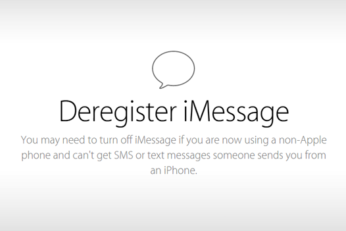
In an effort to offer support to those who have taken the decision to move to a different mobile platform, Apple has built and released a ‘Deregister iMessage’ Web service that allows individual phone numbers to be completely removed from the iMessage messaging platform.
If you happen to be on a capped data plan, you'll know all about using certain apps sparingly while monitoring roaming settings like a hawk. But while it's seemingly obvious that a YouTube binge is going to quickly use up that precious quota, Apple's iMessage is a comparatively silent culprit. After all, you can send images, videos, audio clips and text with relative ease, and unlike with WhatsApp and others, they're not heavily compressed. If you want to keep abreast of iMessage's data-usage habits, checking the amount of cellular MBs used is possible at stock level, and although the feature is a little obscure, you can easily access it with just a little bit of navigation.
If you've been inundated with iMessage spam and don't know how to combat it, there are a couple of different avenues you can explore in the battle against the apparently prevalent spamming.
Spam text messages are nothing new, but security research firm Cloudmark is now warning people of a new approach being taken by those who previously relied on SMS to peddle their spam.
Apple's iMessage, since its introduction, has offered a powerful means through which iOS and OS X users can communicate in a secure, reliable manner. I say reliable, but iMessage hasn't been without its fair share of bugs and downtimes, and in a recurrence of an old issue, it looks as through iMessage is hijacking regular SMS messages and sending them to Apple IDs - even inactive ones.
Talk of Apple being able to read iMessage contents is nothing that new, but it's been at the fore today after the iPhone and iPad maker was forced to reiterate that it cannot see the content of messages, even if it wanted to. That may have put people's minds at rest, and while it should be reassuring, Apple's claim has already had a bog old dollop of doubt thrown at it by jailbreak supremo Pod2g.
Apple has managed to pull off the recent introduction of iOS 7 without too many issues. The initial traffic from user downloads managed to cause a small amount of server downtime in the first few hours of availability, but other than that, it has been relatively plain sailing for the Californian giants. It's probably unreasonable to expect that a major overhaul of an operating system would launch without any service affecting bugs at all, and those iOS 7 converts who have been experiencing iMessage related issues should soon see a permanent fix winging its way to their device through an over-the-air update.
Here are a few workarounds to fix iMessage not working issue in Apple’s iOS 7 for iPhone, iPad and iPod touch.
Apple's iMessage was first introduced along with iOS 5 back in late 2011, and has since processed many billions of messages between iPhone, iPad, iPod touch and OS X Mountain Lion users worldwide. But whilst celebrated for being secure, efficient, and generally reliable, a new-found vulnerability demonstrates just how easily one can be attacked by floods of messages in a DoS-esque manner, to the point where the app locks up and becomes unusable. Many Apple developers, including jailbreak gurus such as iH8Sn0w and chpwn have been targeted in a spate of attacks, and although the culprit’s origins are rather unknown, it's worrying just how easily the attacks were conceived. More details right after the jump.
Making phone calls, checking emails and browsing the web are some of the more useful features of Apple's range of iOS powered gadgets, but the introduction of iMessage meant that even iPod touch and iPad owners can send and receive messages to users who are running iOS 5 and above.